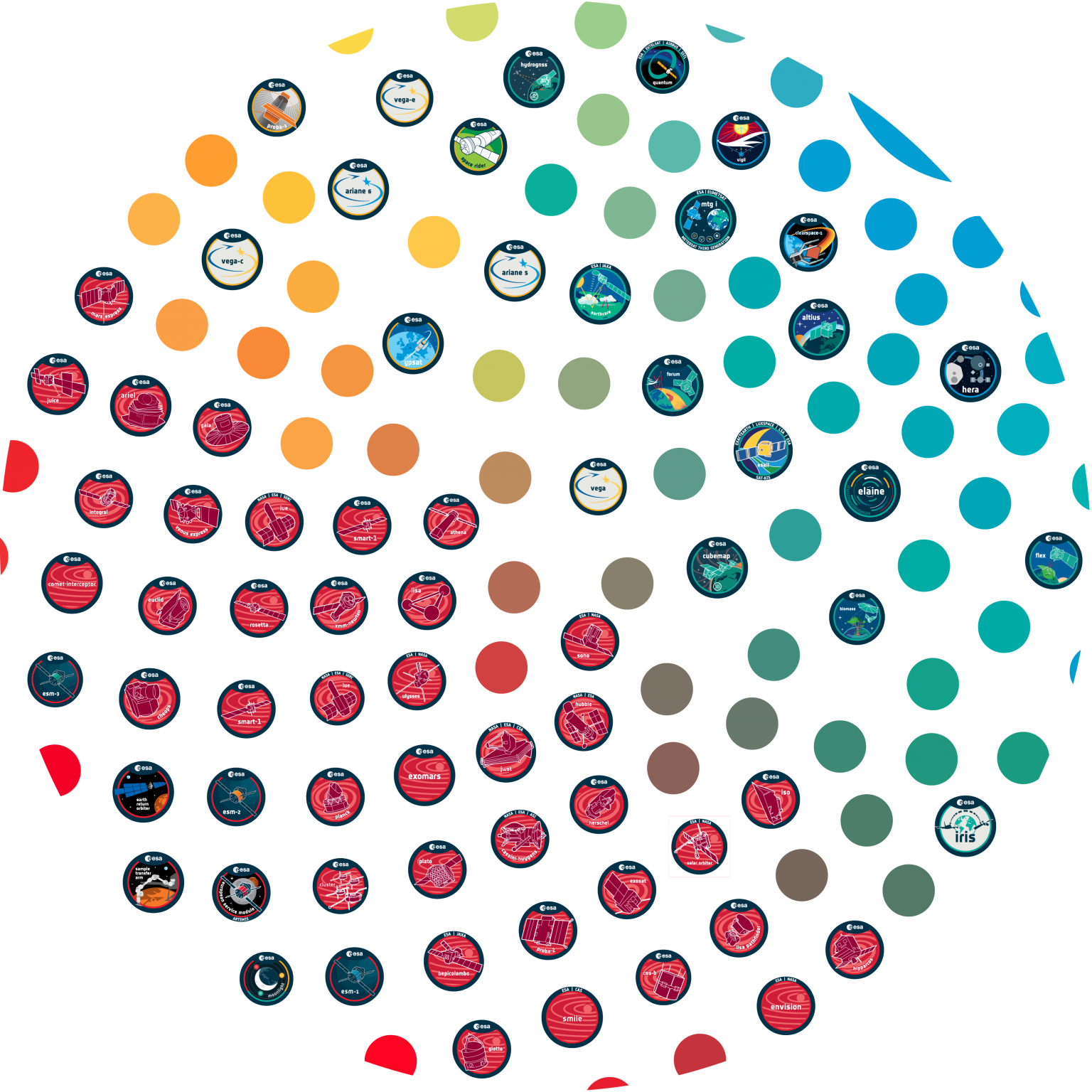
We are pleased to announce our topics for the 2027 ESA Student Internships in Space Science. The student internships are three- to six-month long placements at the Science and Operations Department (SCI-S) and Science Engagement & Oversight Office (SCI-E), based either at ESAC near Madrid, Spain, or at ESTEC in Noordwijk, The Netherlands. The internships cover a wide range of topics in astronomy, planetary science and heliophysics including engineering, scientific data analysis, instrumentation, machine learning, IT, science education, and science communication.
Now open: Call for JUICE Interdisciplinary Scientists and Guest Investigators
JUICE (JUpiter ICy Moons Explorer) is en route to the Jovian system, where it will conduct detailed investigations of Jupiter and its three ocean-bearing moons: Ganymede, Callisto, and Europa. ESA will appoint up to 11 Guest Investigators and three Interdisciplinary Scientists to contribute to the mission's scientific return. Guest Investigators will exploit JUICE data in combination with observations from other missions, ground-based facilities, laboratory experiments, and modelling. The Interdisciplinary Scientists will join the Science Working Team, contributing to the mission's overarching science goals. The Announcement of Opportunity is now open to the scientific community, with proposals due by 17 December 2026.
The Space Telescope Science Institute (STScI) invites all JWST users to complete its annual user survey by 20 November. This includes observers who submitted Cycle 6 proposals and anyone who has worked with JWST data in any capacity. Your experiences and suggestions will help STScI prioritise improvements across all aspects of the JWST user experience. All feedback is highly valued and will be carefully analysed.
Gaia's first principal data release (Gaia DR4) will become publicly available in the ESA space science archives on 2 December 2026 at 12:00 CET. This major milestone will be celebrated with an event at ESA's European Space Astronomy Centre (ESAC) in Spain on 2 December. Several related events organised by the Gaia Data Processing and Analysis consortium and other groups will also take place across ESA member states and beyond. The main Gaia DR4 event at ESAC will be broadcast live online. The programme will include presentations for the general public highlighting some of the first scientific results from the release.
Following an 8-year journey, a quarter of which involved the use of solar electric propulsion, the ESA-JAXA BepiColombo mission is on final approach to Mercury. The Mercury Transfer Module was ejected on 3 September. The ESA Mercury Planetary Orbiter, MPO, and JAXA Mercury Magnetospheric Orbiter, or Mio, are still attached to each other. On 21 November, the two orbiters, plus the MOSIF sunshield that protects Mio, will enter their initial orbit about the planet. Once in Mio’s operational orbit, the orbiters will separate during the night of 9-10 December. During the mission’s science phase, that begins in April 2027, a comprehensive suite of instruments will thoroughly explore Mercury and its environment. Follow the mission’s progress on ESA Science’s social media channels. #bepicolombo
HWO 2026 30 November - 04 December 2026, Paris, France
The Habitable Worlds Observatory (HWO) is NASA's next Great Observatory, with launch planned for the early 2040s. Its large telescope and suite of instruments will support research across astrophysics, from cosmology and galaxy evolution to the Solar System and the search for life on exoplanets. The conference will bring together the scientific community to discuss these themes and the observatory's future scientific programme.
The Origin and Habitability of the Galilean Moons II 23 - 25 March 2027, Tokyo, Japan
The second Workshop on the Origins and Habitability of the Galilean Moons will examine links between the present-day characteristics of Io, Europa, Ganymede and Callisto and their formation conditions and habitability. With a focus on surface materials, geological processes and interior structures, the workshop will help prepare the scientific community for the arrival of ESA's JUICE and NASA's Europa Clipper missions in the Jovian system. Hosted by the Earth-Life Science Institute in Japan, it follows the first workshop in Marseille and is part of a series held at intervals of two to three years before the missions reach Jupiter.
NewAthena Science Conference 19 - 23 April 2027, Prague, Czech Republic
As NewAthena progresses towards mission adoption, this conference will bring together the international high-energy astrophysics community to discuss the mission's scientific goals, future observing programmes and synergies with current and upcoming facilities. It will provide an opportunity to refine the scientific case presented in the Definition Study Report following initial feedback from ESA's advisory structure, share recent results, strengthen collaborations and prepare for the mission's scientific return. Topics will include galaxy groups and clusters, supermassive black holes, compact objects, transient and multi-messenger phenomena, and links between high-energy observations and other major astronomical facilities.
XRISM 2027 01 - 04 June 2027, Detroit, MI, USA XRISM 2027 is the second international conference focused on results from the X-Ray Imaging and Spectroscopy Mission. Topics will include the formation of the Universe's largest structures; its chemical evolution; active galactic nuclei and their environments; the endpoints of stellar evolution; accretion and outflows in compact objects; new physics enabled by high-resolution X-ray spectroscopy; and XRISM's role in multi-wavelength and multi-messenger astronomy.
European Space Agency, D/SCI Directorate of Science
My account
placeholder PeopleEditorPersonalDetails portlet
ESA uses cookies to track visits to our website only, no personal information is collected.
By continuing to use the site you are agreeing to our use of cookies.
OK Find out more about our cookie policy.

 The European Space Agency