





























 Sign in
 Science & Technology
Instruments JEMX - INTEGRAL
Joint European X-ray Monitor: JEM-X
Jérôme Chenevez, DTU SPACE, Copenhagen, Denmark
with collaborating scientific institutes in Denmark (DTU Lyngby), Finland (Metorex Espoo, U Helsinki), Spain (U Valencia, INTA Madrid), Italy (INAF/IASF-Frascati, U Ferrara, INAF/IASF-Palermo, INAF/IASF-Bologna), USA (NASA/GSFC Greenbelt), Sweden (Observatory Stockholm), United Kingdom (U Cambridge), Poland (Copernicus Center Warsaw, Space Research Center Warsaw), Russia (IKI Moscow).
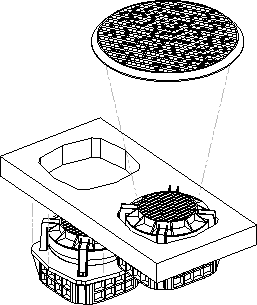
The Joint European X-Ray Monitor (JEM-X) supplements the main INTEGRAL instruments (Spectrometer and Imager) and plays a crucial role in the detection and identification of the gamma-ray sources, as well as in the analysis and scientific interpretation of INTEGRAL gamma-ray data. JEM-X makes observations simultaneously with the main gamma-ray instruments and provides images with arcminute angular resolution in the 3 - 35 keV prime energy band. The baseline photon detection system consists of two identical high pressure imaging microstrip gas chambers (1.5 bar, 90% Xenon + 10% Methane), at nominal gas gain of 1500. Each detector unit views the sky through its coded aperture mask located at a distance of approximately 3.2 m above the detection plane.
For more details we refer the interested reader to ISOC's Announcement of Opportunity documentation of the JEM-X Observer's Manual and to a sequence of papers on the JEM-X payload in the A&A Special Letters issue on: First science with INTEGRAL. This issue also contains various other papers on the first results from in-flight observations. For a description of the JEM-X data analysis we refer to, e.g., Westergaard et al. (2003, A&A 411, L257). The JEM-X validation report of the Off-line Scientific Analysis (OSA) software package released by the ISDC, as well as descriptions of the data analysis pipelines and modules and the use of the OSA software can be found at the ISDC website (https://isdc.unige.ch/integral/analysis#Documentation).
Overview of scientific capabilities of JEM-X
| Energy range | 3 - 35 keV |
| Detector area | 500 cm2 (single unit) |
| Energy resolution | 1.3 keV @ 10 keV |
| Field of view (diameter) | 4.8° (fully illuminated) 7.5° (half response)* 13.2° (zero response) |
| Angular resolution | 3' (FWHM) |
| Point source location accuracy | 1' (90% confidence, 15σ isolated source) |
| Continuum sensitivity for a single JEM-X unit (isolated source on-axis) |
1.2e-4 ph/(cm2 s keV) [3σ in 10e5 s, @ 6 keV, ΔE=E/2] 1.0e-4 ph/(cm2 s keV) [3σ in 10e5 s, @ 30 keV, ΔE=E/2] |
| Line sensitivity for a single JEM-X unit (isolated source on-axis) |
1.6e-4 ph/(cm2 s) [3σ in 10e5 s, @ 6 keV] 1.3e-4 ph/(cm2 s) [3σ in 10e5 s, @ 20 keV] |
| Timing accuracy (3σ) |
122 μs (relative timing) |
* At this angle the sensitivity is reduced by a factor 2 relative to the on-axis sensitivity. In practice, the transmission of the collimator beyond an off-axis angle of 5° is so low that only the very brightest sources can be observed at larger angles.
Back to the INTEGRAL Scientific Payload page
- Removed a total of (2) style text-align:center;
- Removed a total of (1) style text-align:justify;
- Removed a total of (1) style float:right;
- Removed a total of (1) align=center.
- Removed a total of (1) border attribute.